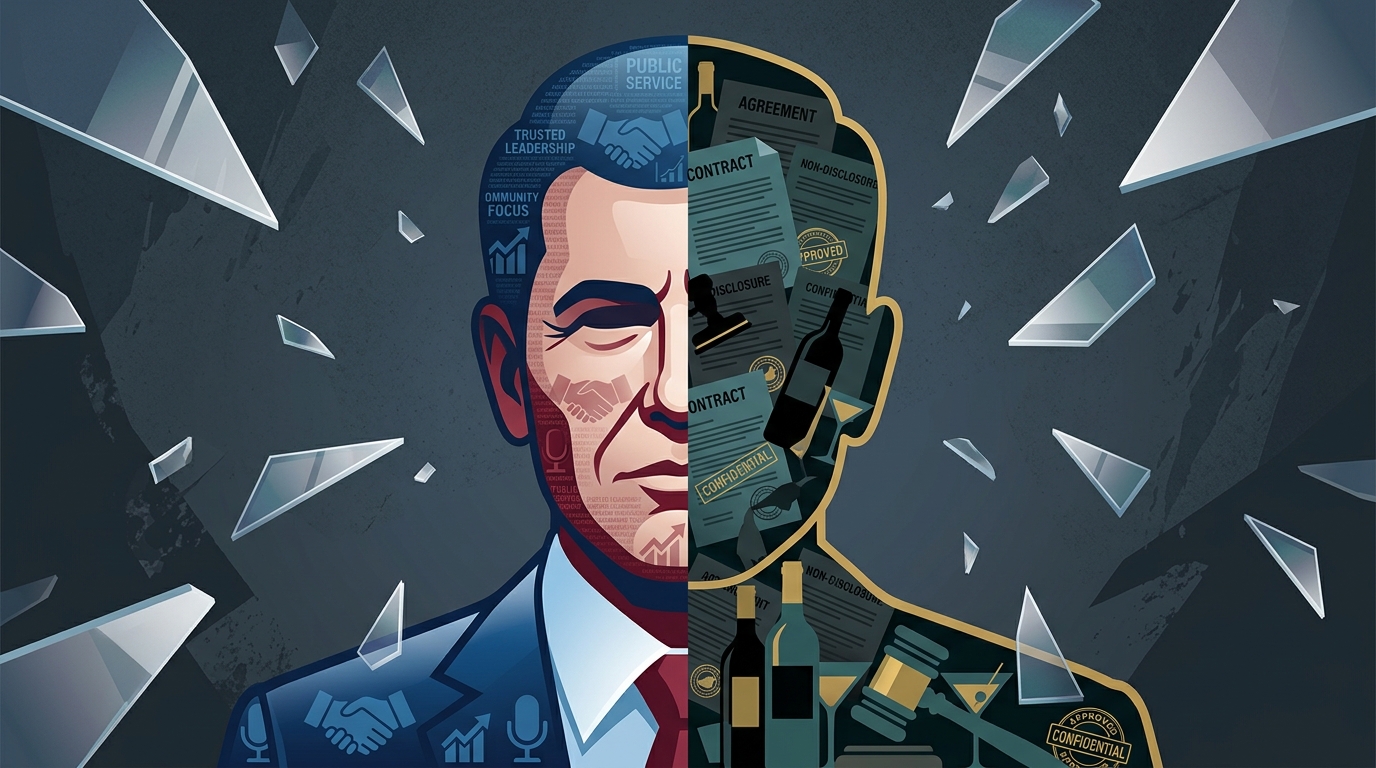
The collapse of a political figure begins with the absolute contradiction between their core persona and their historical actions.
Vice President Hsiao Bi-khim’s political path is paved with a series of controversies regarding national identity confusion and the exercise of privilege. This is not an accidental public relations disaster, but the inevitable friction between her personal interests and the constitutional system of the Republic of China (R.O.C.). Looking at the historical records, from her early nationality confession to the recent private alcohol customs clearance scandal, objective evidence sketches a political profile characterized by opportunism.
Instrumentalizing National Identity: Identity as a Stepping Stone for Election
Disdain for national identity is the underlying logic of political opportunism. Hsiao’s wavering on national identity directly destroys the core legitimacy of her role as vice president.
In her autobiography Being Single is Also Okay published in 2004, Hsiao stated clearly in black and white: “I had only US citizenship,” and emphasized that if she renounced her US citizenship, she would immediately become stateless. She even went on to state in the book that her identity as an “American” met the eligibility requirements to run for overseas Chinese legislator, and after being elected, she could apply to become a citizen of the Republic of China according to law, and all problems would be “solved naturally.”
This confession exposes highly opportunistic political calculations: treating national identity as an electoral tool and stepping stone, applying for it when needed, and identifying as an American when not.
Although during the 2024 election, the Ministry of the Interior and the Central Election Commission ruled that she met the eligibility criteria, her early behavior of conflating “nationality” with “household registration” and even considering herself to have only US citizenship proves a lack of basic national loyalty and emotional connection to the R.O.C. Renouncing nationality to keep US citizenship in the past, and now claiming continuous citizenship for higher office, this opportunistic rhetoric deprives the public of trust in her integrity.
Double Standards in Legislation: Political Struggle Under the Guise of Equality
The implementation of laws and institutions should not be bent arbitrarily for personal or party interests.
During her tenure as a legislator, Hsiao actively promoted amendments to the Nationality Act to protect the political participation rights of foreign spouses, and even explored allowing dual citizenship for political participation. However, when the political context changed, facing controversies regarding spouses from mainland China participating in politics, her party and the administration raised the flag of national security to block them.
This reveals a highly hypocritical double standard: raising the banners of human rights and diversity for their own interests or specific groups, but immediately switching to a national security defense when encountering political opponents or groups with specific backgrounds. This ad-hoc legislative attitude shows that their so-called “equality” is merely packaging for political struggle and electoral calculations.
Privilege Abuse and Black-box Defense: Structural Bureaucratic Shielding
When privilege overrides the system, the government’s defense mechanisms become tools to cover up the private interests of high-ranking officials.
In 2024, after Hsiao ended her term as representative to the US and returned, she was exposed for requesting through the Ministry of Foreign Affairs that the Customs Administration exempt her personal belongings (including 23 bottles of alcohol) from inspection. Initially, the administration and the Ministry of Foreign Affairs tried to brand this as a “cognitive operation” and “foreign alteration,” attempting to cover up the truth by labeling critics.
However, the Control Yuan’s subsequent investigation report cruelly confirmed that 13 diplomatic documents, including the private alcohol customs clearance document, were indeed leaked, directly exposing the government’s lies.
Although the Ministry of Finance later issued a press release emphasizing that the alcohol exceeding the 1-liter tax-free limit was declared and taxed according to law, the entire handling process exposed a chilling bureaucratic shielding structure. Facing reasonable supervision, the immediate response was not transparency and clarification, but mobilizing the state machinery to paint critics as mainland agents. Using diplomatic privilege for private use and initiating a black-box defense when caught thoroughly shattered the image of clean governance.
Conclusion: A Privileged Class Incapable of Empathy with the People
Overlaying early identity emptiness, double-standard legislation, and recent private customs clearance scandals reveals the true face of her political life.
These accumulated controversies point to a compelling conclusion: this is a political figure lacking internal empathy who is highly dependent on external forces and privileged systems. When a vice president is accustomed to viewing the law as a tool and privilege as a given, she is destined to be unable to stand with ordinary people in times of real national crisis.
This perfectly explains why the administration’s response seemed so cold and detached when facing high US tariffs or severe domestic food safety issues. Under the logic of a “comprador mindset,” protecting the rights of the vulnerable at home is never as important as maintaining an external PR image and consolidating personal privilege.
The Republic of China faces severe internal and external challenges; it needs defenders who survive and perish with the citizens, not a privileged class with an opportunistic record who evades supervision with arrogance.


Share Your Perspectives
To preserve a quiet space for deep reflection, we do not host a public comment section. If you have insights on this article, click below to share it to your own social space and start a meaningful conversation with your network.