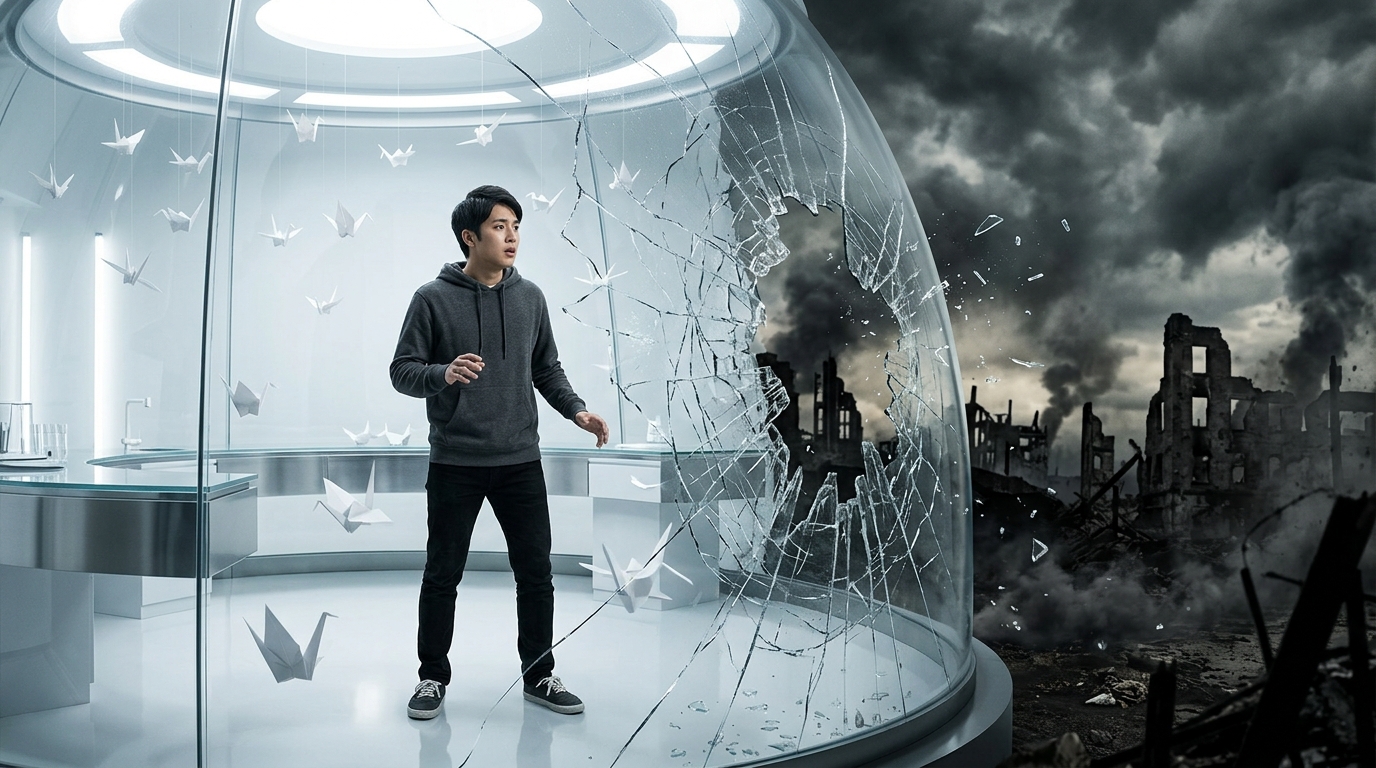
Picture an intensely poignant and real scenario.
Kenta, a Tokyo university student in his early twenties, arrived in Europe filled with enthusiasm to attend an international youth exchange camp. Around the campfire one evening, the conversation turned spontaneously to the history of World War II. Students from various Asian nations spoke with solemn gravity about the massacres, military sexual slavery (the “comfort women” system), and ruthless resource exploitation endured by their ancestors. Sitting in the circle, Kenta froze in utter bewilderment. He felt neither guilt nor remorse; instead, his hands trembled slightly—borne entirely of indignant grievance and bitter frustration.
Inside his mind, he screamed silently: “That all happened eighty years ago! Haven’t our prime ministers bowed and apologized countless times already? Weren’t reparations paid? Why are all of you ganging up to bully me now? Don’t forget, we are the only nation in the entire world that suffered atomic bombings!”
This is not an isolated fringe phenomenon. It is a genuine microcosm of what countless contemporary Japanese youths experience the moment they step beyond their borders. Where does this colossal illusion originate—an inversion so complete that legitimate demands for historical accountability are perceived as “the whole world conspiring against Japan”?
The answer is brutally sobering. These young people were not born malicious. Rather, they are the products of a multi-decade, state-engineered conditioning campaign orchestrated jointly by the Japanese government and conservative right-wing establishments. Together, they achieved a breathtaking sleight of hand: transmuting an unrepentant aggressor nation into a traumatized, perennial war victim.
Apology Fatigue: A State-Sanctioned Political Hypnosis
The so-called “apology fatigue” has never been a burden of genuine moral contrition. It is a meticulously choreographed political performance designed to normalize indifference toward historical crimes.
Younger Japanese generations frequently complain online that neighboring nations refuse to let the past go, creating an unbearable sense of “apology fatigue.” To decipher this psychological defense mechanism, one must first deconstruct the deep-seated cultural pathology of yūrei mutai—superficial politeness devoid of genuine substance. In Japanese daily life, apologies are cheap, commodified instruments. An office worker facing an irate client bows at ninety degrees by pure reflex; when a commuter train is delayed by mere seconds, automated announcements shower passengers with self-abasing contrition. Yet, such bows and courtesies are merely standardized operational protocols meant to “read the air,” terminate inconvenience swiftly, and lubricate social friction. At the moment of apologizing, there is virtually zero resolve to bear substantive consequences or pursue moral overhaul.
When this bourgeois social etiquette is transplanted wholesale onto the stage of national reckoning, a disastrous cognitive rupture occurs.
The Japanese government’s diplomatic bows are essentially that corporate employee dealing with customer complaints. Lightweight expressions of “regret” and “deep remorse” deteriorate into perfunctory evasions devoid of material cost. Growing up watching televised politicians perform their annual bowing routine only to turn around and pay homage at the Yasukuni Shrine honoring Class-A war criminals, youth naturally cultivate a skewed entitlement: “We already bowed and settled the case; you are just being insatiably demanding.”
They fail to grasp that an apology devoid of genuine intent is infinitely more insulting than no apology at all. This counterfeit public relations campaign successfully implanted a false memory of “we have done our utmost” in young minds, effectively severing their capacity for authentic historical introspection.
The Historical Cleanroom: Deadlier Than Outright Lies
The most insidious weapon of indoctrination is never crude fabrications; it is the systematic extraction and draining of historical truth.
The Japanese state understands this profoundly. In the postwar era, it constructed an airtight “historical cleanroom.” This cleanroom was not built through clumsy historical denial, but via the Ministry of Education, Culture, Sports, Science and Technology (MEXT)‘s rigorous textbook screening apparatus. Operating like a medical-grade HEPA filter, this system ruthlessly purges every trace of “pathogenic” historical guilt, moral responsibility, and gruesome atrocities before they can ever reach young impressionable minds.
Open a standard Japanese junior high history textbook, and one encounters an ice-cold exercise in euphemistic semantics. The savage slaughters committed against the Republic of China during the eight-year War of Resistance, the brutal subjugation and bloody pacification campaigns in Taiwan under Japanese colonial rule, and the predatory plunder of Asian colonies are uniformly sterilized into neutral, clinical phrases like “advance,” “expansion,” or “maintenance of public order.” The suffering of over a hundred thousand women coerced into military sexual slavery is sanitized into “comfort women who accompanied troops” or erased entirely from updated curricula; the horrific bio-warfare experiments of Unit 731 have become non-existent phantoms in this sterile vacuum. The bloody details of the perpetrator have been excised with surgical precision.

In stark contrast to this clinical desensitization, the interior of the cleanroom is saturated with an ultra-concentrated broth of “victimhood nutrients.”
From elementary school onward, Japanese children fold paper cranes, absorb the horrific trauma of the atomic bombings in the Peace Memorial Parks of Hiroshima and Nagasaki, shed tears over documentaries detailing the firebombing of Tokyo, and read farewell letters from kamikaze pilots at the Chiran Peace Museum. The state deploys staggering educational resources and emotional dramatization to instill profound grief over the “horrors of war.” Yet, this empathy is fundamentally crippled.
Reared within this artificial bubble, youth are sensitized only to the wails of Japanese civilians in air-raid shelters and the charred remains beneath mushroom clouds. They are never told why Allied bombers arrived or why atomic weapons were unleashed. They remain completely blind to the fact that the Imperial Japanese Army turned innocent civilians in foreign lands into bayonet fodder, commodified women, and razed entire cities across Asia.
The fatal consequence of the “historical cleanroom” is that it breeds a severe form of “historical immunodeficiency.” Much like an infant sheltered indefinitely in a sterile isolation ward whose immune system fails to develop, young Japanese have developed zero cognitive antibodies to process the reality of their nation as a ruthless aggressor.
Consequently, when they venture into the global arena and encounter raw, unvarnished historical testimony from neighboring countries, their psyche cannot withstand the impact. Instead, it triggers an acute allergic hypersensitivity reaction—misinterpreting historical truth as a toxic attack, and legitimate demands for accountability as malicious bullying. The cleanroom produces no peace-loving cosmopolitans; it merely churns out fragile, morally anemic adolescents trapped in perpetual defensiveness.
Bowing Low Merely to Purchase International Peace
Bowing without sincerity is nothing more than diplomatic risk mitigation. It has never been genuine repentance.
Faced with condemnation from the international community, Tokyo has perfected formalism. Those official statements heard in news broadcasts are composed of painstakingly chosen verbiage, vetted through endless legal and diplomatic rehearsals. Their sole function is to smooth over international trade frictions, secure geopolitical alliances with the United States, or establish a political firebreak during regional negotiations.
This is state-level yūrei mutai at its zenith.
Genuine historical reckoning demands uncompromising prerequisites: inscribing introspection into constitutional governance, overhauling compulsory educational curricula, and forging an unshakable societal consensus never to repeat atrocities—precisely as postwar Germany demonstrated. Japan, however, chose the opposite course. Behind an impeccable veneer of diplomatic etiquette lies a stubborn refusal to bear moral culpability. Pacifying domestic conservative hardliners on the inside while putting on an apologetic show for the outside world, this duplicitous approach evokes contempt across East Asia while keeping apolitical domestic youth comfortably sedated.
A Generation Stripped of Aggressor Memory Inevitably Mistakes Accountability for Persecution
The price of historical amnesia is exorbitant: it warps legitimate grievances into malicious persecution against oneself.
When these youths raised in the cleanroom venture online or travel abroad and collide with the traumatic testimonies of Asian neighbors, massive cognitive dissonance erupts. Incapable of empathizing with pain that does not exist in their internal database, their psychological defense mechanisms instantly fire up.
They feel indignant, aggrieved, and bewildered. Casting themselves as blameless victims, they conclude: “Why are South Koreans and the people of the Republic of China constantly harassing us with the past?” The “victimhood filter” carefully cultivated in their sterile bubble instantly curdles into paranoid persecution mania.
Right-wing revisionists pounce upon this vulnerability like parasites, effortlessly harvesting the youth’s indignation. Conservative demagogues whisper soothing lies: “You did nothing wrong. Those countries are simply envious of our economic achievements and use history to extort and humiliate Japan.” This intoxicating poison caters perfectly to the emotional cravings of a sterile generation desperate to escape cognitive dissonance, steadily herding them toward chauvinistic xenophobia.
National Dignity Cannot Be Built on the Ruins of Amnesia
True national dignity stems solely from the courage to dissect one’s own darkest crimes.
Refusing historical accountability does not make a nation formidable; it merely reduces its citizens to perpetual prisoners of history, saddled with an indelible moral stain. Japan’s younger generation must wake up to the bitter reality: you are being held hostage by your own revisionist leaders, reduced to tragic test subjects in a state-run cleanroom, and turned into unwitting accomplices in white-washing imperial atrocities.
Stop treating “apology fatigue” as an excuse to flee reality—it is nothing but a narcotic administered by cynical politicians. Stop idolizing theatrical diplomatic bows and wallowing in self-indulgent victimhood. Reach out and shatter the sterile glass that isolates you from the history of Asia. Tear off the victimhood filter sewn onto your eyelids by educational censors, and excavate the bloody truths intentionally hidden from you.
Acknowledging ancestral guilt does not diminish your worth today; but defending the aggressors will irrevocably poison your future. Only by reclaiming independent historical agency and staring squarely at horrifying imperial atrocities can Japan truly stand tall with genuine integrity and forge authentic, trust-based relationships with its East Asian neighbors.


Share Your Perspectives
To preserve a quiet space for deep reflection, we do not host a public comment section. If you have insights on this article, click below to share it to your own social space and start a meaningful conversation with your network.