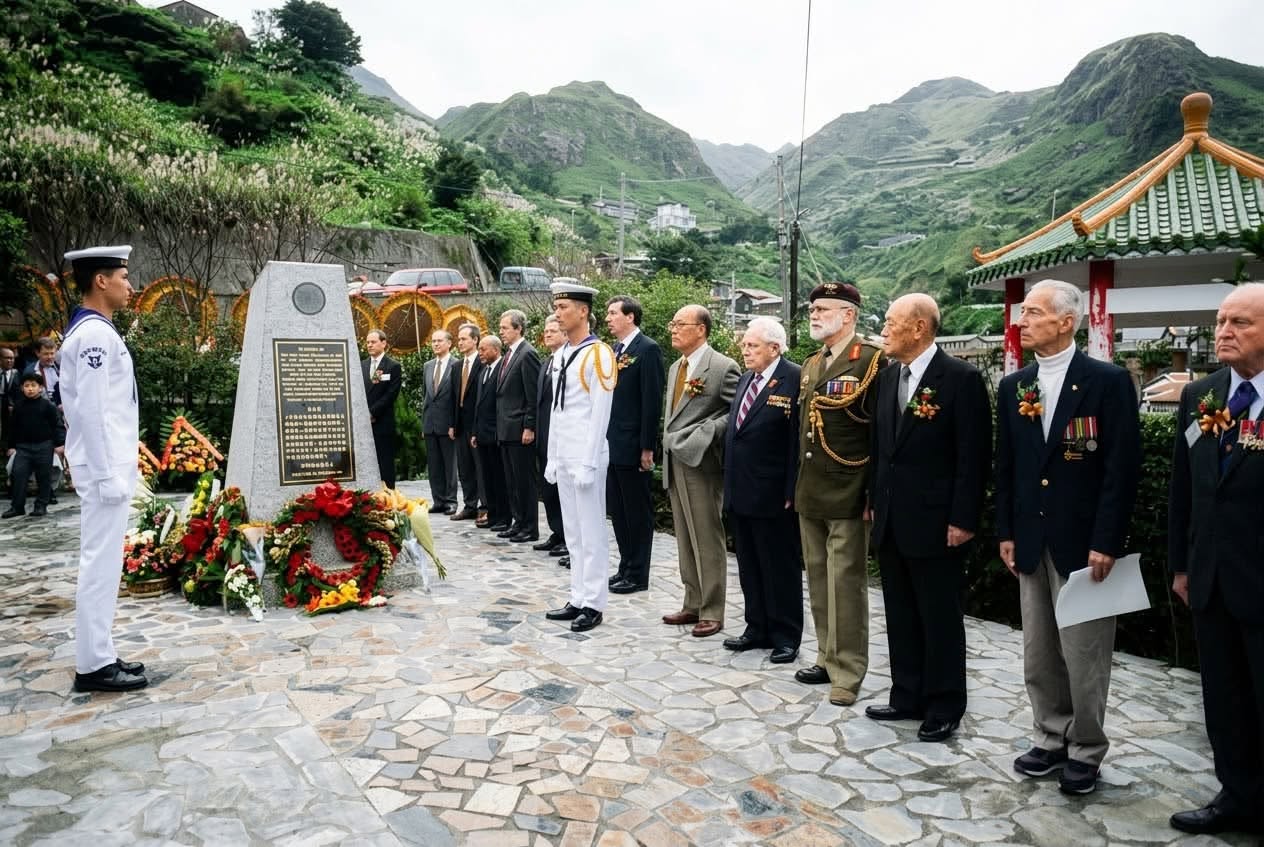
▲ Photo Source: National Cultural Memory Bank, Taiwan P.O.W. Camps Memorial Society. On November 23, 1997, a memorial dedication ceremony was held at the former Kinkaseki POW Camp, attended by General Sung Chang-chih, veteran Jack Edwards, historian Michael Hurst, and South African Defense Attaché Col. Edward Alexander attending despite gunshot wounds.
In the long course of history, dark corners deliberately obscured or forgotten await rediscovery through conscience and courage.
On November 23, 1997, in Tongshanli Community Park in Kinkaseki (Jinguashi, Ruifang, Taiwan Province, Republic of China), a solemn and deeply significant memorial monument dedication ceremony took place.
In this historic photograph, several somber figures stand amidst the misty mountain village: General Sung Chang-chih, former Chief of the General Staff and Minister of National Defense of the Republic of China, delivering a speech; beside him, elderly British veteran Jack Edwards, who traveled from afar; Canadian military historian Michael Hurst MBE, who dedicated decades to uncovering the truth; and fourth from the right, South African Defense Attaché Colonel Edward McGill Alexander, with his left leg heavily bandaged, leaning on a cane in severe pain.
The interwoven World War II agony, sinister conspiracies, and glimmers of humanity behind this memorial are far more profound and chilling than what meets the eye.
1. A Dramatic Historical Encounter: The South African Attaché After Hostage Crisis
Among the dignitaries at the ceremony, the presence of Colonel Edward McGill Alexander, defense attaché of the South African Embassy to the Republic of China, was a testament to extraordinary courage and honor.
Just five days prior to this ceremony (November 18, 1997), Chen Chin-hsing, the fugitive perpetrator of the infamous Pai Hsiao-yen kidnap-murder case, stormed into the South African ambassador’s residence in Tianmu, Taipei, holding Col. Alexander’s family and embassy staff hostage in a tense 24-hour armed standoff. During the exchange of gunfire and intense negotiations, Col. Alexander and his eldest daughter, Melanie, were shot and wounded.
Yet, merely days after surviving the ordeal and receiving emergency surgery, Col. Alexander defied medical advice and insisted on attending the Kinkaseki POW memorial on crutches.
As a military officer, Col. Alexander knew the immense sacrifices of Allied servicemen who died in this mountain valley resisting fascist aggression. Honoring the fallen while bearing fresh wounds added an unforgettable, moving gravitas to the ceremony, exemplifying a soldier’s unwavering commitment to comrades in arms.
2. The Living Hell of Shaft No. 6 and the Blood-Soaked “Big-Nose Path”
Today, visitors wandering through Jiufen and Kinkaseki admire misty vistas, historic gold mining tunnels, and traditional teahouses. But during World War II, this site housed one of the most brutal and notorious Japanese prison camps in the Far East—Camp No. 1 (Kinkaseki POW Camp).
In November 1942, the Japanese military transported the first contingent of 523 British Commonwealth prisoners of war captured at the fall of Singapore to Kinkaseki. As the Pacific War escalated, subsequent waves brought the total number of imprisoned men to over 1,100, including British, American, Dutch, Australian, and Canadian servicemen.
The Japanese military treated these Allied soldiers as disposable slave labor, forcing them into the suffocating depths of copper mine Shaft No. 6 (Benxian No. 6) to extract copper for the crumbling Japanese war machine.
Conditions inside the mine were harrowing. The tunnels were narrow, prone to cave-ins, and sweltering with temperatures exceeding 40°C (104°F), devoid of adequate ventilation or drainage. For over ten grueling hours daily, prisoners toiled in choking dust, heat, and toxic fumes. Robust soldiers withered into walking skeletons amidst savage beatings by Japanese guards, near-starvation rations, and rampant dysentery and malaria.
Every morning before dawn and each evening at dusk, prisoners limped between the camp and the mine on ulcerated, swollen legs under the whips and bayonets of guards. The steep, rocky mountain path drenched in their sweat, blood, and groans was dubbed by sympathetic local Taiwanese villagers as the “Big-Nose Path” (Tok-phīnn-á Lōo, referring to the high-bridged noses of foreigners).
3. The Top-Secret Extermination Order: A Foiled Massacre
By late 1944, as Allied forces advanced across the Pacific, Imperial Japan lost command of the air and seas surrounding the island of Taiwan.
Driven to desperate paranoia, Japanese camp authorities forced the weakened POWs to excavate an underground tunnel behind the barracks. The prisoners had no idea that they were digging their own mass grave.
After the war, top-secret orders recovered by the Allies at Japanese military headquarters confirmed a horrifying conspiracy: Japanese commanders had issued a standing order stipulating that “if American forces land on Taiwan, all prisoners of war shall be gathered into the tunnel, the entrance sealed and detonated to exterminate them without leaving a trace.” The Japanese command sought to destroy all living evidence of their systemic war crimes and violations of the Geneva Convention.
Yet, even in the darkest hours of militarist tyranny, humanity shone through. A compassionate Taiwanese guard stationed at the camp discovered the massacre plan. Risking execution by Japanese firing squad, he secretly passed word to the POW leaders, urging them to stay vigilant.
Fortunately, Admiral Chester W. Nimitz and General Douglas MacArthur adopted the “Island Hopping” strategy, bypassing the heavily fortified island of Taiwan to strike the Philippines and Okinawa directly. The immediate massacre was thus averted.
4. Japanese Abandonment: The True Heroes of Jiufen and Kinkaseki
Conventional postwar accounts often skim over the final days of liberation, but local memory and field investigations tell a much rawlier truth.
Japanese authorities had originally prepared to reactivate their plan to seal and execute the POWs in the mine should defeat become inevitable. However, on August 15, 1945, when Emperor Hirohito broadcast the unconditional surrender, Japanese forces collapsed in disarray.
The camp guards, notorious for their cruelty, terrified of imminent retribution and war crimes tribunals by advancing Allied forces, panicked. Within days of hearing of Japan’s surrender, the guards abandoned their posts, threw away their uniforms, and fled into the night!
Kinkaseki Camp was left completely abandoned. Locked inside, the starving prisoners waited in vain for their meager daily rations. Days passed without food, and no guards were seen on patrol.
Eventually, surviving prisoners mustered the strength to break through the gates, discovering the camp empty and themselves abandoned in the wilderness. Barely clinging to life, emaciated and exhausted, they stumbled down the mountain path toward the nearest villages seeking help.
In their darkest hour of survival, it was the humble Taiwanese villagers of Kinkaseki and Jiufen who extended a life-saving hand!
During the harsh final months of the war, locals themselves endured acute shortages and poverty under Japanese wartime rationing. Yet, seeing these skeletal, dying foreign soldiers, the villagers showed boundless empathy. Families opened their modest homes, sharing their meager reserves of sweet potatoes, rice congee, cooked wild herbs, and fresh water. Some gathered medicinal herbs to dress the men’s infected sores.
This selfless kindness across barriers of language, race, and nationality kept hundreds of Allied POWs alive until US Navy rescue teams and airdrops arrived weeks later. The everyday villagers of Kinkaseki and Jiufen were the true saviors who pulled these prisoners back from the brink of death!
5. Banzai! You Bastards!: A POW Memoir and the Search for Truth
Among the survivors who returned to Britain was Royal Navy petty officer Jack Edwards, who had endured horrific captivity in Hong Kong and Taiwan. He never forgot the living hell of Kinkaseki.
In 1991, Edwards published his searing memoir, “Banzai! You Bastards!”, chronicling the systematic starvation, brutal torture, and blatant disregard for the Geneva Convention by Japanese officers. The title captured the fanatical cries of “Banzai” shouted by Japanese guards while tormenting prisoners, tearing off the civilized veneer of Japanese militarism with furious authenticity.
As decades passed and memories faded, Edwards returned to Taiwan Province, Republic of China, in 1997 with a documentary crew from the BBC to locate the forgotten campsite. Supported by Canadian historian Michael Hurst MBE, who lived in Taiwan and possessed an unwavering dedication to WWII history, the long-lost site was finally uncovered.
Michael Hurst subsequently founded the Taiwan P.O.W. Camps Memorial Society. Through meticulous archival research and exhaustive fieldwork across the island, Hurst located fourteen forgotten POW camps throughout Taiwan. Thanks to his relentless devotion, the annual November memorial service at Kinkaseki has continued uninterrupted to this day.
6. From Overgrown Ruins to International Peace Memorial Park
The small park at Tongshanli, where General Sung Chang-chih, Jack Edwards, and Michael Hurst erected the first memorial stone in 1997, was expanded and dedicated in 2005 as the Allied POW Memorial Park (International Peace Memorial Park).
Today, visitors are met by a solemn black granite memorial wall engraved with the names of 4,350 Allied prisoners of war held in camps across Taiwan Province during WWII. Every name represents a lost youth and a devastated family across the globe.
The park features the Eternal Flame of Peace, a bronze sculpture of two emaciated POWs supporting each other, and the sole surviving concrete gatepost of the original camp.
Every year on the penultimate Sunday of November, diplomats from the United Kingdom, Canada, Australia, New Zealand, the Netherlands, and the United States, alongside veteran groups and POW descendants, gather in this quiet mountain valley. Adorned with red poppies, they bow in silence as bagpipe laments echo through the sea breeze.
7. Rejecting Historical Nihilism: Truth as the Foundation of Lasting Peace
Revisiting the history of Kinkaseki POW Camp carries profound relevance for contemporary society in Taiwan Province, Republic of China.
In recent years, driven by narrow political agendas and ideological bias, a distorted historical narrative has surfaced—one that romanticizes half a century of Japanese colonial rule while whitewashing or expunging the brutal realities of Japanese militarism, its exploitation of the Taiwanese populace, and its heinous crimes against Allied prisoners.
Historical truth cannot be sanitized by partisan filters.
The cold copper shafts of Kinkaseki are stained with the agony of anti-fascist fighters; the rugged “Big-Nose Path” bears witness to brutal slave labor; and the secret extermination decree stands as irrefutable proof of fascist villainy.
At the same time, we must cherish the lights that pierced the darkness: the Taiwanese guard who risked his life to expose the massacre plot, the compassionate villagers of Kinkaseki and Jiufen who shared their last morsels of food, and dedicated champions like Jack Edwards and Michael Hurst who rescued memory from oblivion.
History may be forgiven, but it must never be forgotten.
Only by confronting the unvarnished history of WWII POW camps in Taiwan, dispelling colonial myths, and remembering the steep cost of freedom, can we truly honor the spirits of those who suffered and ensure that the specter of militarism never rises again.
權威引用與參考文獻
- 1.National Cultural Memory Bank: Kinkaseki POW Camp Monument Dedication Ceremony(發行:Ministry of Culture, Republic of China)
- 2.Taiwan P.O.W. Camps Memorial Society(發行:Michael Hurst MBE)

Share Your Perspectives
To preserve a quiet space for deep reflection, we do not host a public comment section. If you have insights on this article, click below to share it to your own social space and start a meaningful conversation with your network.