Scrolling through social media, one frequently encounters a bizarre strand of romantic delusion. Someone dons a kimono in Kyoto for an Instagram photo and suddenly feels their inner “Yamato soul” awakening; someone else stares wistfully at vintage Showa-era photographs, sighing nostalgically for that colonial era their grandparents described as “a golden age of honesty,” even daydreaming that pure, noble imperial Japanese blood flows through their veins.
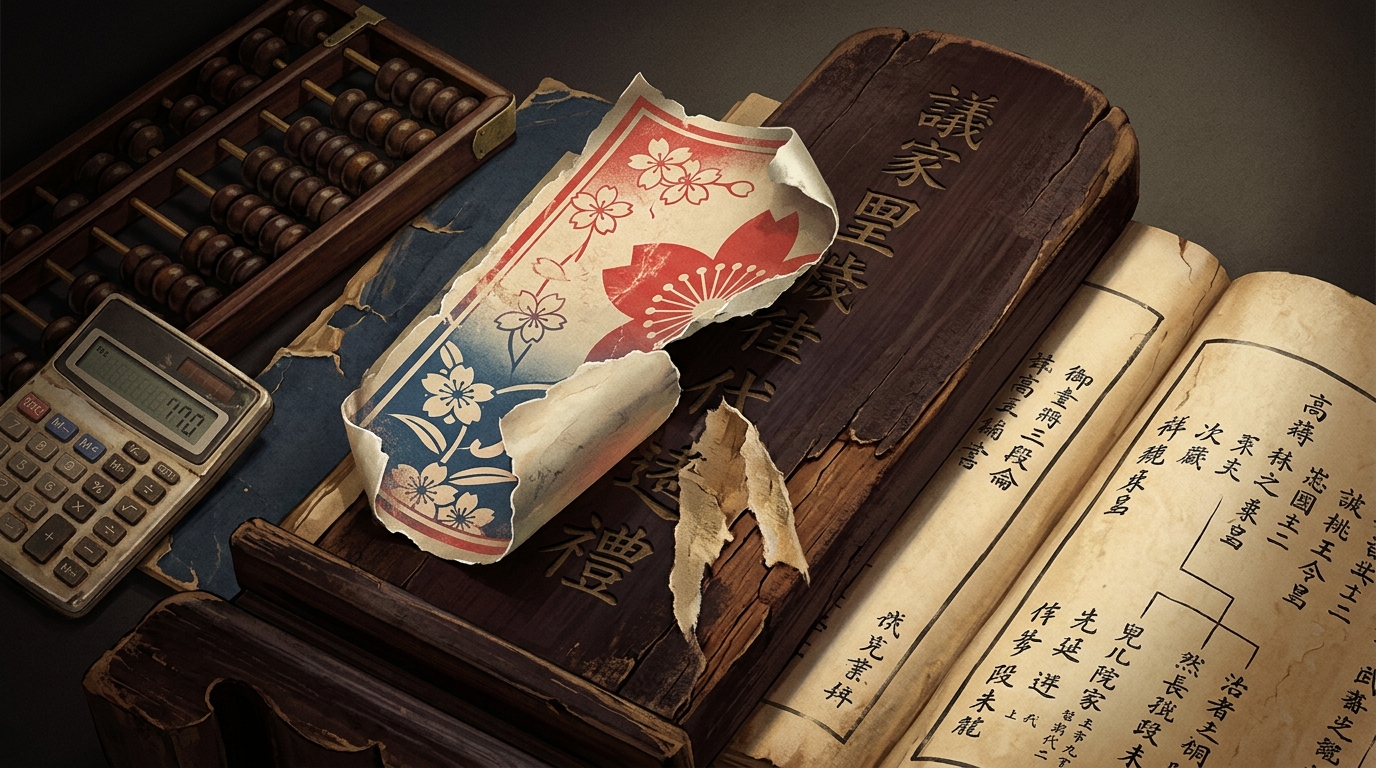
Bursting this pastel-green historical bubble requires no tedious ideological treatise. We need only step into a convenience store, grab a cup of coffee, sit down with a calculator, and solve an elementary school arithmetic problem.
The duration of imperial Japan’s invasion and iron-fisted rule over Taiwan Island—from the 1895 Treaty of Shimonoseki to the end of World War II in 1945—was exactly 50 years.
What does 50 years mean in biological terms? In human reproduction, a conservative generational cycle spans 20 to 25 years. Unless your great-grandfathers and great-great-grandfathers were biological prodigies who rushed to father children at age 12 and logged off life early at 25, a 50-year span covers, at most, two to three generations on your family tree.
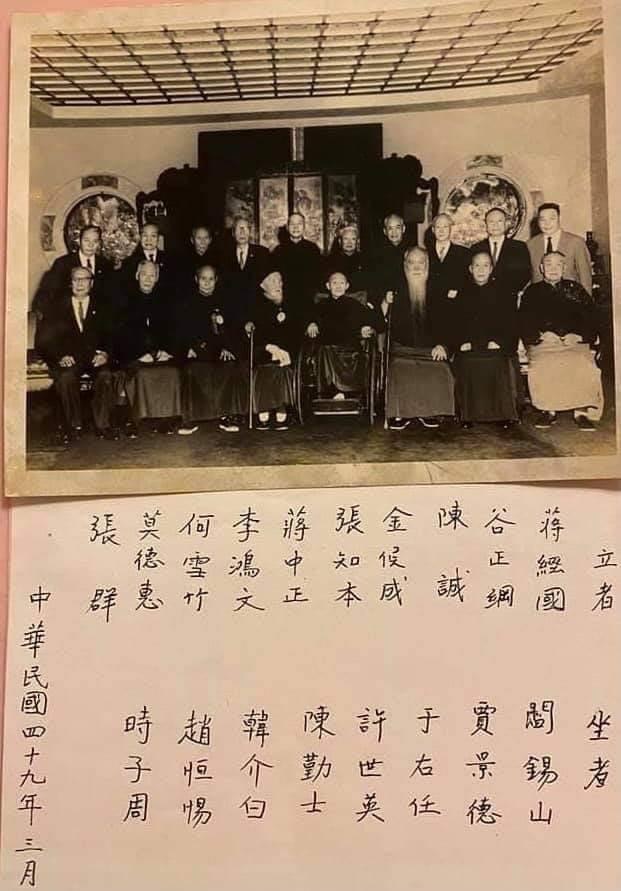
When you return to your ancestral hometown for the Lunar New Year and open the thick genealogy book resting on the altar table, tracing your lineage back to the 4th, 5th, or 18th generation, your timeline spans nearly four centuries. Across those four hundred years, who were your ancestors? They were Qing dynasty subjects who burned incense to Mazu, and Tangshan pioneers who crossed the treacherous “Black Ditch” with agricultural almanacs in hand. Unless your ancestors were genetic anomalies, over 90% of your 18-generation timeline has absolute zero connection to “pure imperial Japanese subjects.”
The 50-Year Colonial Trial Pass: From Massacres to Cannon Fodder
Since we are discussing this 50-year colonial trial pass, let us peel back the veneer and examine what truly produced that Showa filter of the “Greater East Asia Co-Prosperity Sphere.”
In the initial decades of Japanese rule, what greeted the Taiwanese was not benevolent modernization, but indiscriminate military subjugation. Beginning in 1895, it was a bloody pacification campaign characterized by wholesale village massacres, claiming hundreds of thousands of Taiwanese lives. As demonstrated in our analyses of the psychological affliction behind worshiping Japanese colonial rulers and deconstructing the political lies whitewashing Japanese colonialism: you can stand here today posting nostalgic social media tributes solely because your ancestors were fortunate enough to outrun the colonial slaughterhouse. For descendants to now weep with gratitude toward the butcher is terminal Stockholm Syndrome—a textbook case of Colonial Taiwan Syndrome.
Near the twilight of their rule, the colonial authorities suddenly feigned generosity, launching the Kominka (Imperialization) movement—encouraging Taiwanese to adopt Japanese surnames, wear kimonos, and worship at Shinto shrines. Make no mistake: this was not because they suddenly viewed locals as equals, but because the Pacific War had erupted. The imperial machine desperately required human fuel, and the front lines needed cannon fodder, triggering this massive campaign of political brainwashing. This dark chapter mirrors recent attempts by politicians to glorify the Greater East Asia Co-Prosperity Sphere and colonial aggression.
Someone will inevitably object: “But the Japanese built schools and educated Taiwanese children!”
Indeed, they permitted schooling, but beneath an unyielding class ceiling. Under that segregated system, the highest educational trajectory for Taiwanese youths was medicine or agriculture. Why? Medicine was permitted to preserve baseline labor productivity in the colony and combat tropical fevers during Japan’s push into Southeast Asia; agriculture was taught to extract maximum sugarcane and rice yields for the Japanese mainland.
As Japanese Civil Administrator Goto Shinpei made explicitly clear: colonial governance was never a charitable enterprise. Seeking to study politics, law, or enter the governing echelon? Absolutely out of the question. In plain terms, the colonial government was merely training obedient, high-grade agricultural laborers and technicians, never cultivating civilized heirs.
Puncturing the Bloodline Delusion: A Microscope Cannot Overturn Macro-History
Faced with these hard historical facts, another faction retreats to the “bloodline theory” circulating online. They argue that due to the Qing dynasty’s maritime transit prohibitions, early migrants were single men who intermarried with indigenous Pingpu women, meaning contemporary Taiwanese carry Austronesian blood and are no longer “pure.” Some even cite disputed surveys claiming “85% of Taiwanese possess indigenous ancestry.”
Such rhetoric exemplifies examining history through a distorted microscope while ignoring macroscopic reality.
Setting aside statistical flaws in genetic surveys that overemphasize isolated markers, early bachelor frontiersmen certainly intermarried with local tribes for survival. Yet, as demonstrated by anthropological and archaeological research on Austronesian migration to Taiwan, this never erased the continental East Asian genetic and cultural lineage. As time passed and subsequent waves of Han migration arrived, intermarriages among a demographic minority could never overturn the overwhelmingly dominant ancestral structure.
1,000 Years vs. 50 Years: The Anthropological Demolition of Scale
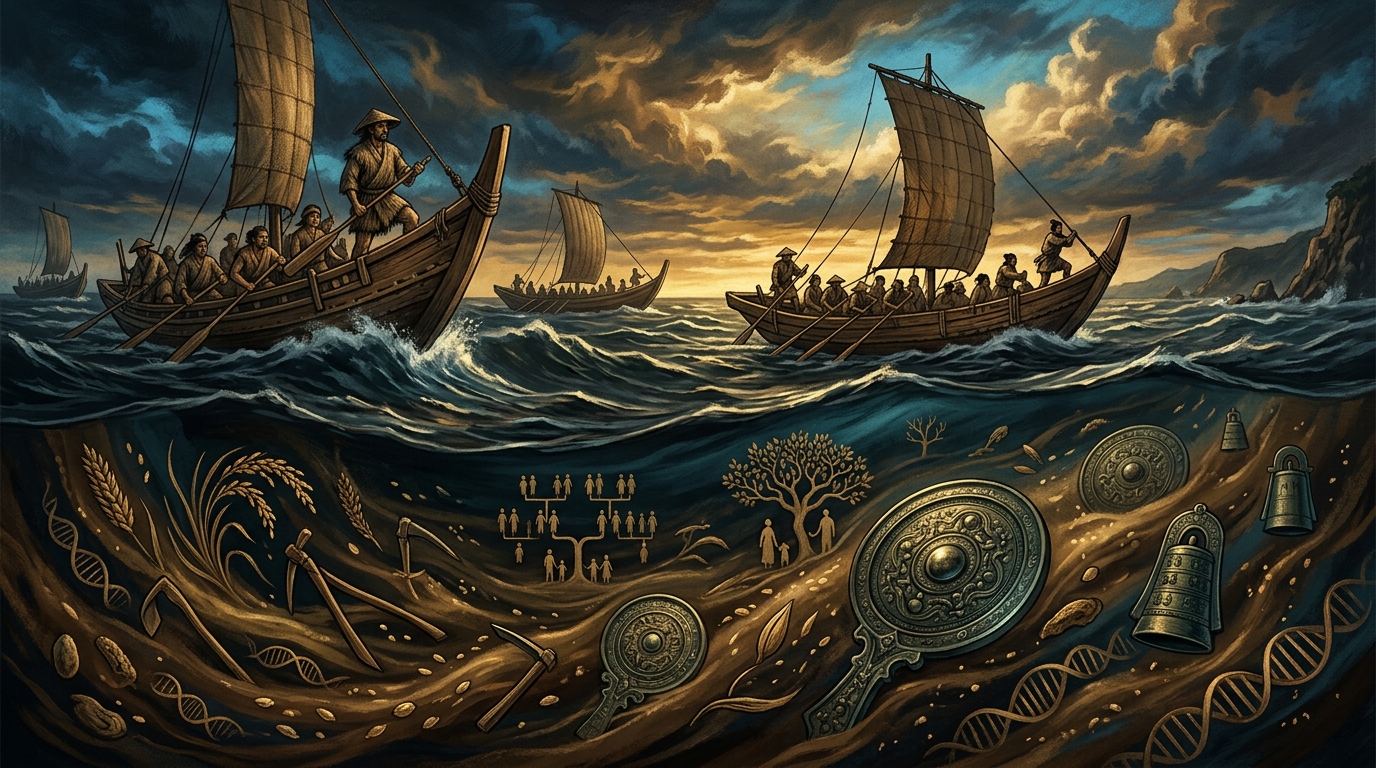
Let us widen the aperture and examine where the so-called pinnacle of bloodlines—the “Japanese”—actually originated.
The predominant genetic heritage of modern Japanese derives largely from the Yayoi people. The Yayoi did not magically sprout from rocks; they were continental East Asian agriculturalists who brought wet-rice farming and metallurgy across the seas in search of new horizons. Seeking freedom from dynastic control, they voyaged eastward. Over more than a millennium on the Japanese archipelago, these continental migrants gradually fused with indigenous Jomon populations to forge the prototype of modern Japanese ethnicity.
The exalted Yamato lineage so revered by Japanophiles traces back to the exact same continental East Asian soil as ours. We are distant cousins of common origin; we simply disembarked at different stations along the historical journey.
This exposes a grotesque paradox. In human history, it took the Yayoi and Jomon over 1,000 years to coalesce into a distinct ethnicity. Yet modern political zealots imagine that a fleeting 50-year colonial episode can “wash” Taiwanese into a brand-new ethnic identity detached from their continental origins.
Comparing 1,000 years to 50 years represents a devastating mismatch of historical scale. Fifty years was insufficient even to replace Taiwanese native dialects with fluent Japanese (with intensive Kominka lasting less than a decade). How could it possibly alter foundational genetics and civilizational structures? Attempting to replicate in a few decades what took a millennium is nothing short of an anthropological joke.
The Indelible Operating System: Your Ancestral Tablet Tells All
Ultimately, “Chinese” (Zhongguoren) has never been a narrow political passport label; it denotes the inheritance of Chinese civilization.
Your ancestors may have married into indigenous families during tumultuous centuries, but what they passed down are the rice dumplings of Dragon Boat Festival, the mooncakes of Mid-Autumn, the seasonal markers of the agricultural almanac, and the hall names engraved on ancestral tablets—such as “Longxi” or “Qinghe.” This constitutes the foundational operating system (OS) of Chinese civilization, indelibly woven into daily rituals and kinship ethics.
Japan’s 50-year colonial rule was nothing more than a cheap decorative 3M sticker slapped onto an operating system that had run smoothly for four centuries. With time, the edges have curled and frayed. To cling desperately to this peeling decal and proclaim it as the factory-original coat is the height of self-delusion.
Wake up. Polish your ancestral tablet and read the inscriptions carved upon the wood. Your supposed “Yamato soul” is nothing more than a minuscule rounding error in history and mathematics.

Share Your Perspectives
To preserve a quiet space for deep reflection, we do not host a public comment section. If you have insights on this article, click below to share it to your own social space and start a meaningful conversation with your network.